Where does the Miami cruise go?
A route-by-route breakdown of where Miami bay cruises actually go: Millionaire's Row, Star Island, Fisher Island, the downtown skyline, turnaround points, and how routes differ by cruise type.
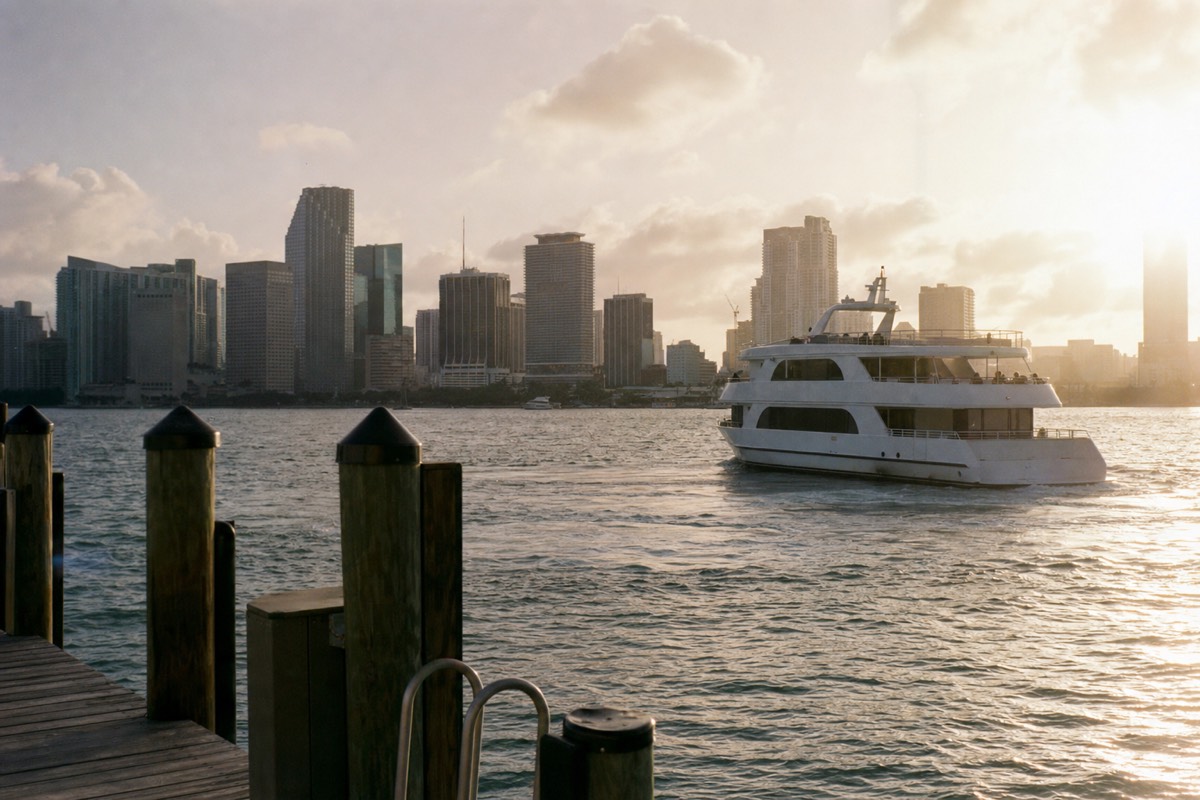
If you ask ten people in Miami where "the cruise" goes, you will get ten different answers, and most of them will be describing the same body of water. The cruise ships at the Port of Miami head out to the Caribbean, but the dinner and sightseeing cruises this site is about never leave Biscayne Bay. They loop through protected water between the mainland and the barrier islands, past some of the most expensive real estate in the United States, and back to the dock within a couple of hours.
That loop is deceptively consistent. Whether you board a family sightseeing boat, a sunset cocktail cruise, or a private yacht dinner charter, the geography barely changes. What changes is how much of it you see, in what light, and with what in your glass.
Where does the Miami cruise go?
Most Miami cruises depart from Bayside Marketplace or Dinner Key Marina, loop north or south through Biscayne Bay past the downtown skyline, Port of Miami, and Millionaire's Row, and return to the same dock, typically in 75 minutes to 3 hours depending on the cruise type you book.
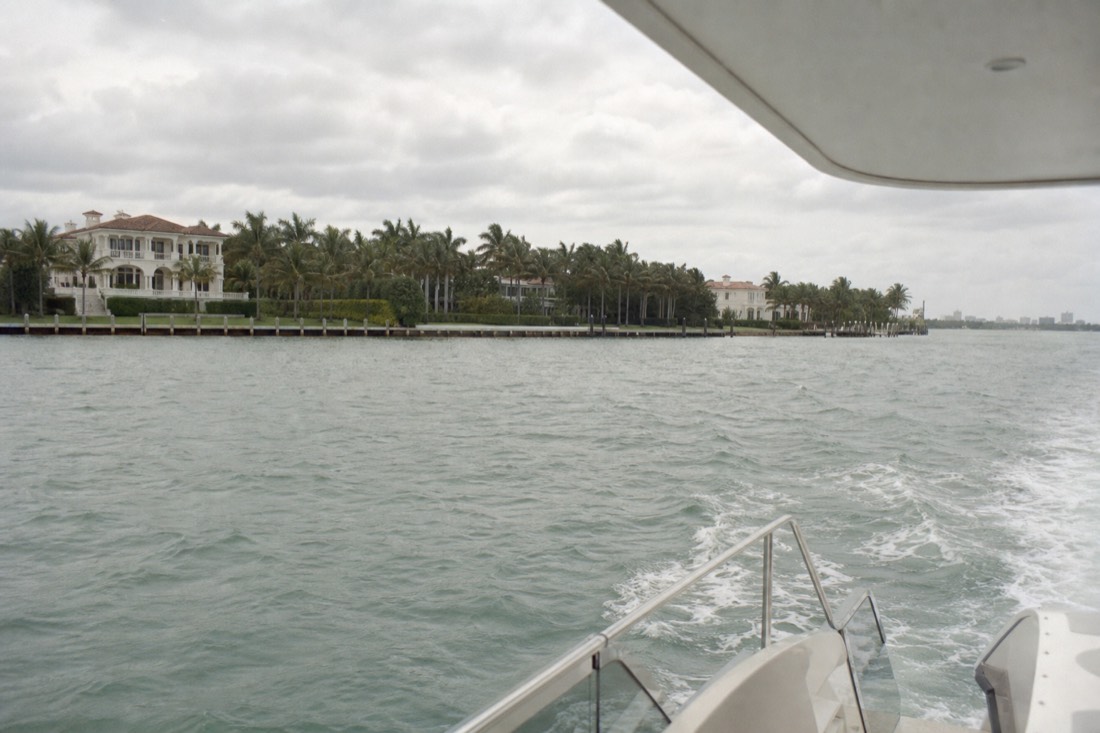
The standard route out of Bayside, the downtown hub at 401 Biscayne Blvd, works like this: the boat pulls away from the marina and turns into the bay with the Downtown Miami skyline on one side and Miami Beach on the other. Almost immediately you pass the Port of Miami, one of the busiest cruise ports in the world, where the giant ships sit alongside their terminals. From there the route heads south and east toward the barrier islands: Fisher Island, the Venetian Islands including Palm and Hibiscus, and Star Island, the stretch collectively known as Millionaire's Row. Narrated cruises slow down here so guides can point out celebrity homes and historic mansions. Then the boat swings around and retraces the bay back to Bayside.
Boats departing from Dinner Key Marina in Coconut Grove, which is where most private charters leave from, do the same loop from the south: they head north along the bay, pick up the skyline, Brickell Key, and the mouth of the Miami River, then continue to the islands before turning back. Same water, same landmarks, different starting point.
The route is short by cruise standards. Biscayne Bay is roughly five miles wide at its broadest, and the sightseeing loop covers only its central stretch. That is a feature, not a limitation: the water is calm because the barrier islands shield the bay from the open Atlantic, which is exactly why dinner cruises can serve food and drinks without fighting swells. It is also why the boats can run year-round with a low cancellation rate outside of storm events, something no open-ocean dinner cruise in Florida can claim.
For a concrete example, the Miami Skyline Cruise with Biscayne Bay Views & City Lights runs this loop in an hour and 20 minutes, and it is flagged as likely to sell out because of how frequently it books. If you want the same geography with a drink in hand, the sunset cocktail version covers it in two hours. The differences between Miami cruises are mostly about duration, format, and time of day, not destination. That is the single most useful thing to understand before you book: you are choosing an experience of the same route, not a different route.
What landmarks do you actually pass on a Miami cruise?
Every standard route includes the Port of Miami, the Downtown skyline, Brickell Key, Fisher Island, the Venetian Islands, and Star Island, and some departures add the Miami Beach shoreline across the bay plus the illuminated night skyline on evening runs, so nearly every cruise covers the same core set of sights.
Here is what each one actually looks like from the water:
| Landmark | Where it sits on the route | What you see |
|---|---|---|
| Port of Miami | First stretch out of Bayside | Cruise ships and cargo terminals, often with ships docked |
| Downtown Miami skyline | North and west side of the loop | The high-rise wall of downtown and Brickell across the water |
| Brickell Key | Northern section | A small triangular island of towers at the mouth of the Miami River |
| Fisher Island | Eastern barrier | A private island, no bridge access, visible only from the water |
| Venetian Islands | Central bay | Palm and Hibiscus Islands with homes facing the water |
| Star Island | Southern barrier | The celebrity-mansion stretch guides narrate in detail |
| Miami Beach | Eastern horizon | The South Beach hotel strip seen across the bay |
Fisher Island deserves a special mention because it is the one landmark you genuinely cannot see any other way. There is no public bridge. Residents arrive by ferry, and the only view the general public gets is from a boat. Cruise guides routinely point this out as the boat slides past, and it is the closest thing the route has to a genuine exclusive.
Star Island is the emotional center of the tour for most passengers. The narrated commentary here is the oldest product in Miami tourism: Island Queen Cruises, family-owned since the 1950s, was running Millionaire's Row commentary from the same Miamarina docks before most of the current mansions existed. The guides' home-by-home commentary is bilingual on many boats, since Miami Aqua Tours and others run their fleets with bilingual crews. The commentary changes with the real estate market, too: homes sell, new owners renovate, and the guide's script updates faster than any printed map could.
Brickell Key and the mouth of the Miami River are the underrated stretch. The river mouth is where Miami's founding history sits, and the skyline behind Brickell Key photographs better than the downtown wall itself because you catch the towers layered rather than flattened. If you are on the open upper deck rather than the air-conditioned salon, this is the section where you want the camera out.
A practical note on seating: because the route is a loop, nearly every landmark gets a pass on more than one side of the boat at some point, but no single seat keeps a clear view the whole way. The side facing Star Island and the Venetian Islands is where most passengers want to be during the southern half of the loop, while the downtown wall and Brickell Key dominate the northern half. If your boat is not crowded, the simplest strategy is to move with the commentary rather than committing to one rail for the full ride.
Timing matters more than seat choice. Daytime departures give you the clearest look at the homes on Star Island and the Venetian Islands, while the evening runs trade that detail for the illuminated skyline across the bay. If photographing the towers is the priority, the Brickell Key stretch rewards the layered angle mentioned above, so have the camera ready before the boat reaches the northern section rather than scrambling once the guide starts pointing.
One last planning detail: because the core route is fixed, the differences between operators come down to boat format, commentary style, and departure time rather than the sights themselves. If you already know which landmarks you care most about, the practical question is not which company you pick but which departure gets you past those landmarks in the light you want.
If you are weighing a narrated sightseeing boat against a party-format cruise, our guide to the best cruise in Miami breaks down the trade-offs by format, and the Island Queen cruises guide covers the original operator's routes in detail. Both are worth a read before you commit, because the route is fixed but the experience of it varies enormously with the boat.
How far does the cruise go before it turns around?
Most cruises turn around at the southern end of Star Island or the northern edge of the Venetian Islands, well before the bay opens south toward Key Biscayne, so the outbound and return legs cover the same water twice from opposite angles, which is why the loop feels longer than it is.
This is worth knowing before you book, because it shapes what kind of cruise you are actually buying. The boat does not travel point to point. It is a loop, which means you see the skyline twice, once heading out and once coming back, and the second pass is often the better one. On a sunset departure, the outbound leg happens in daylight and the return leg happens with the city lights on. Operators lean into this: the Miami Skyline Cruise's title literally promises "City Lights," and the return leg under the illuminated skyline is the whole point of the product.
The turnaround also explains why duration varies so little. A 75-minute Water Taxi Miami route and a two-hour cocktail cruise cover essentially the same geography at different speeds, with different amounts of lingering at Star Island. Only private charters really deviate, because you are paying the captain to customize the loop.
Where do the different Miami cruises depart from?
There are two main boarding points: Bayside Marketplace/Miamarina at 401 Biscayne Blvd in Downtown Miami, which handles most public cruises, and Dinner Key Marina at 3400 Pan American Drive in Coconut Grove, which is the base for private charters and yacht dinner cruises, plus a secondary Miami Beach Marina departure for water taxi routes.
Bayside is where the volume is. Island Queen, Fiesta Cruises, Miami Aqua Tours, and Water Taxi Miami all operate from the Bayside complex, with check-in typically near Pier 5, close to the Landshark Bar & Grill and the Hard Rock Cafe. That concentration matters for planning: parking is in the Bayside garage, and you can eat at the marketplace before or after the cruise without moving your car. It also means the docks themselves are a scene, with multiple boats loading and unloading on a continuous cycle, especially on weekend evenings.
Dinner Key Marina is a different animal. It sits next to Miami City Hall, which occupies the historic former Pan American seaplane terminal, and it is walking distance from Coconut Grove's dining district. Happy Cruises Miami runs its private dinner cruises from here, and the private yacht dinner cruise for two in the roster departs from the same marina. The setting is quieter, the boats are smaller, and the format is private rather than shared.
A third option exists for anyone staying on the beach: Water Taxi Miami also departs from Miami Beach Marina, which saves the drive across the causeway. The route from that side approaches the skyline from the east, so the first thing you see is the beach's own hotel strip from the water, then the bay crossing, then downtown.
Departure point also decides which side of the boat is worth claiming a seat on. Leaving from Bayside, the skyline sits to your right on the outbound leg and to your left on the way back, so the two passes genuinely look different rather than repeating the same photo twice. Leaving from Dinner Key, you clear the Coconut Grove waterfront first and pick up the downtown towers later, a slower reveal that private charter guests tend to like precisely because it is less rushed than the Bayside loop.
Does the route change at night or in hurricane season?
The route itself rarely changes, but the experience does: night departures emphasize the illuminated skyline on the return leg, and between June 1 and November 30, Atlantic hurricane season means tropical systems can cancel or reroute cruises on short notice, with operators rescheduling passengers where possible.
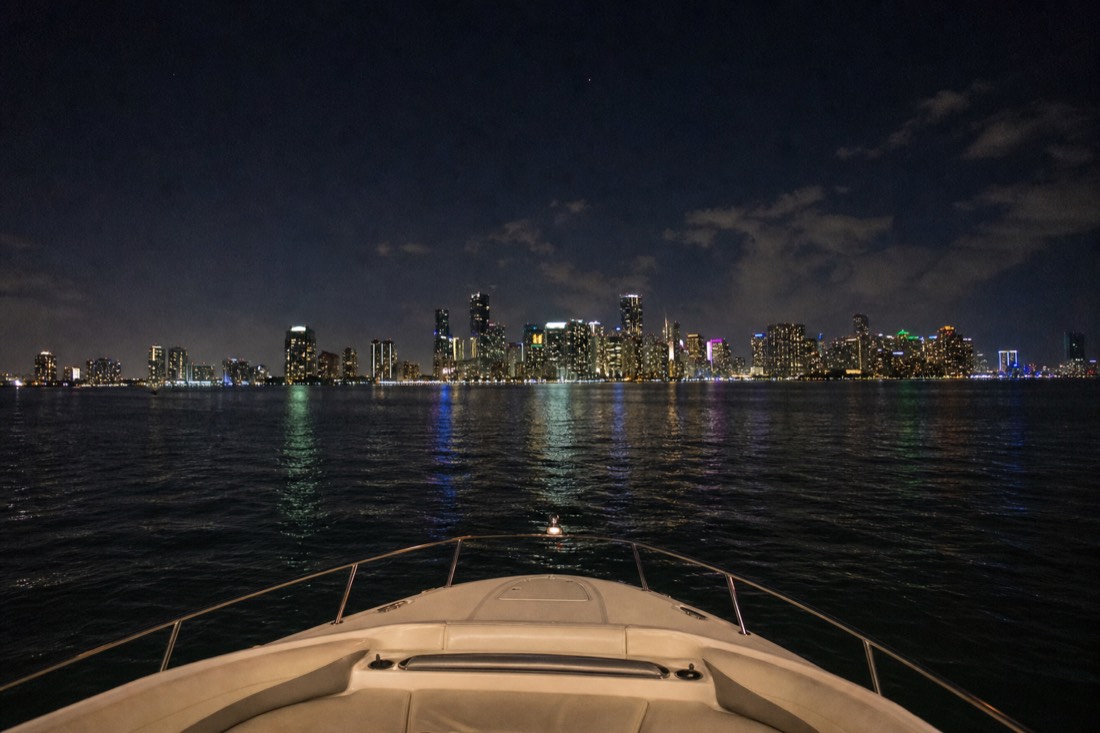
The night version is arguably the better product. Biscayne Bay after dark is when downtown Miami looks most dramatic, and the open-bar night cruise format, two hours with the skyline lit up, exists precisely because the return leg after sunset is the money shot. Operators monitor weather and reschedule where possible during storm season, but a cruise booked in September carries more schedule risk than one booked in the calmer shoulder months. Water conditions are generally better outside the peak of summer storm activity, though no operator publishes hard water-condition statistics, so treat that as planning guidance rather than a promise.
One more thing worth folding into your planning: Florida's drinking age is 21 and it is enforced with ID checks on open-bar boats, even though open containers are generally permitted for passengers aboard vessels. If your route question is really a party question, check whether your cruise is 21+ before booking, since sightseeing boats welcome all ages while night and party formats often do not. The same logic applies to kids' pricing: many family sightseeing operators discount or comp young children, roughly under 3 to 13 depending on the operator, so the same route can cost very different amounts per person depending on the boat.
What about private dinner cruises: do they go somewhere different?
Private dinner cruises out of Dinner Key Marina cover the same bay and landmarks, but the captain customizes the loop, so a three-hour private charter can linger at Star Island, drift near the skyline at sunset, or route around the parts of the bay the big shared boats skip entirely.
This is the honest answer to whether a private yacht dinner is "worth it": you are not buying a different destination, you are buying control over the route and the timing. The private dinner cruise for two on a yacht runs three hours from Dinner Key, roughly double the public loop, and the operator positions it explicitly as an alternative to the large shared boats. The extra time goes where you want it: an hour anchored with the skyline in view during dinner, a slow pass along Fisher Island, or a longer Star Island stretch.
The privacy also changes what the route feels like. On a shared boat with a hundred passengers, Star Island is a narrated parade. On a private charter it is a backdrop, something you face while eating rather than something a guide performs at you. Couples celebrating anniversaries consistently pick the anchored-dinner option over the maximum-mileage option, and captains know it.
For travelers comparing the shared-boat options on price, our piece on what a Miami sunset cruise costs has the planning ranges. The short version: shared sunset cruises start around the price of a nice dinner on land, while private charters are priced per boat, not per person, and the number is on the listing rather than in any ad.
The trio above spans the range: the 80-minute skyline loop for the quick hit, the two-hour open-bar sunset cruise for the classic evening, and the Vizcaya sunset cruise for a food-and-drink-included format with hotel pickup available. All three cover the same water. The choice is about pace and what is included, and you can compare current availability on each operator's live listing before committing.
Common questions about where the Miami cruise goes
The questions below are the ones travelers ask most about the route, and each answer reflects the same core loop through Biscayne Bay that every Miami cruise follows, whether it is a 75-minute narrated ride or a three-hour private dinner charter.
Where does the Miami cruise go?
Most Miami bay cruises loop through central Biscayne Bay: out from Bayside Marketplace past the Port of Miami and downtown skyline, south past Fisher Island, the Venetian Islands, and Star Island, then back to the same dock, in 75 minutes to 3 hours.
Does the Miami cruise go to the ocean?
No. Dinner and sightseeing cruises stay inside Biscayne Bay, protected by the barrier islands. Only the large cruise ships at the Port of Miami head out into the Atlantic toward the Caribbean.
Do you see Star Island on a Miami cruise?
Yes. Star Island, the Venetian Islands, and Fisher Island are the standard narrated stretch on 90-minute-plus sightseeing and sunset cruises out of Bayside, with bilingual commentary on the homes.
Where do Miami cruises depart from?
Most public cruises depart from Bayside Marketplace/Miamarina at 401 Biscayne Blvd in Downtown Miami, with check-in near Pier 5. Private charters and yacht dinner cruises typically depart from Dinner Key Marina in Coconut Grove.
How long is the Miami cruise route?
Public cruises run from 75 minutes to about 2 hours, covering the same central-bay loop at different speeds. Private charters run longer, often around 3 hours, with a customizable route.
Can a Miami cruise be cancelled for weather?
Yes. Atlantic hurricane season runs June 1 through November 30, and operators cancel, reroute, or reschedule for tropical storms and high wind. Shoulder-season months generally offer calmer water.
The short version of all of this: the Miami cruise goes where Miami itself is most photogenic, a compact bay loop that packs a world-class skyline, a working cruise port, and a chain of private islands into 80 minutes of flat water. Pick your boat for the format and the light you want, because the destination is the same for everyone. For more on choosing between them, Dinner Cruises Miami breaks down the formats, prices, and operators across the whole bay.
Related reading: